

Share sale or business sale? How to decide?
July 2026
Rating system:
Reading time (1-10 minutes): 2 (somewhat more if you really want to read the special tax supplement)
Sophistication level (1 (idiot) – 10 (expert)): 4 (7 if you read the special tax supplement)
Entertainment value (1 (turgid) – 10 (side-splitting)): 3 (2 if you read the special tax supplement)
This is the eighth and FINAL Guide in my series of Guides about the differences between share sales and business (asset) sales. You should ideally be aware of these if you are a business owner who might ever want to sell (or buy) a business (or a company…).
This Guide explains some of the reasons sellers and buyers might prefer a share sale to an asset sale, or vice versa. It is quite a short Guide because the basic reasons should be quite simple to understand and I didn’t want to go over old ground covered already in the previous Guides. Also, the temptation to get bogged down in detail was stopping me getting this final Guide out and I want to move on to other subjects!
However, tax is usually a big reason and for those of you keen on tax and keen on detail I have added a special tax supplement in small print at the end!
Why go for a share sale
1. Tax.
In most cases the tax benefits for a seller of having a share deal rather than an asset deal will considerably exceed the tax benefits to a buyer of having an asset deal rather than a share deal. On an asset deal you might have two tax hits – for the seller company on the sale, and for the company owners when looking to distribute the sale proceeds. Also, on a share sale the sellers may benefit from tax reliefs (the Substantial Shareholding Exemption for corporate owners, and Business Asset Disposal Relief for individual owners). The special small print supplement at the end of this Guide goes into a bit more detail on the pros and cons on the tax side.
2. Logistical simplicity
On the face of it a share deal is logistically much simpler. To buy a company a buyer just needs to get share transfer forms signed by all the shareholders transferring all the shares in the company to the buyer; and the current directors of the company need to resign and be replaced by new directors appointed by the buyer. That’s it. The company and its business just carry on seamlessly under new ownership. Whereas for a business sale the sale contract needs to identify and address transfer mechanics and risk issues for each category of asset which is to be transferred. See my ‘Getting your ducks in order’ Guide for more.
3. Continuity
Whilst an asset sale will include a sale of goodwill, and the buyer can present itself to customers and other third parties as carrying on the same business under the same name as when carried on before the sale by the seller, with a share sale everything is seamless – the target company just carries on business as usual, and so far as customers and other third parties are involved nothing has changed. The company still has the same history, same record at Companies House, same historic accounts, same everything.
Why go for an asset sale
1. Warts and skeletons
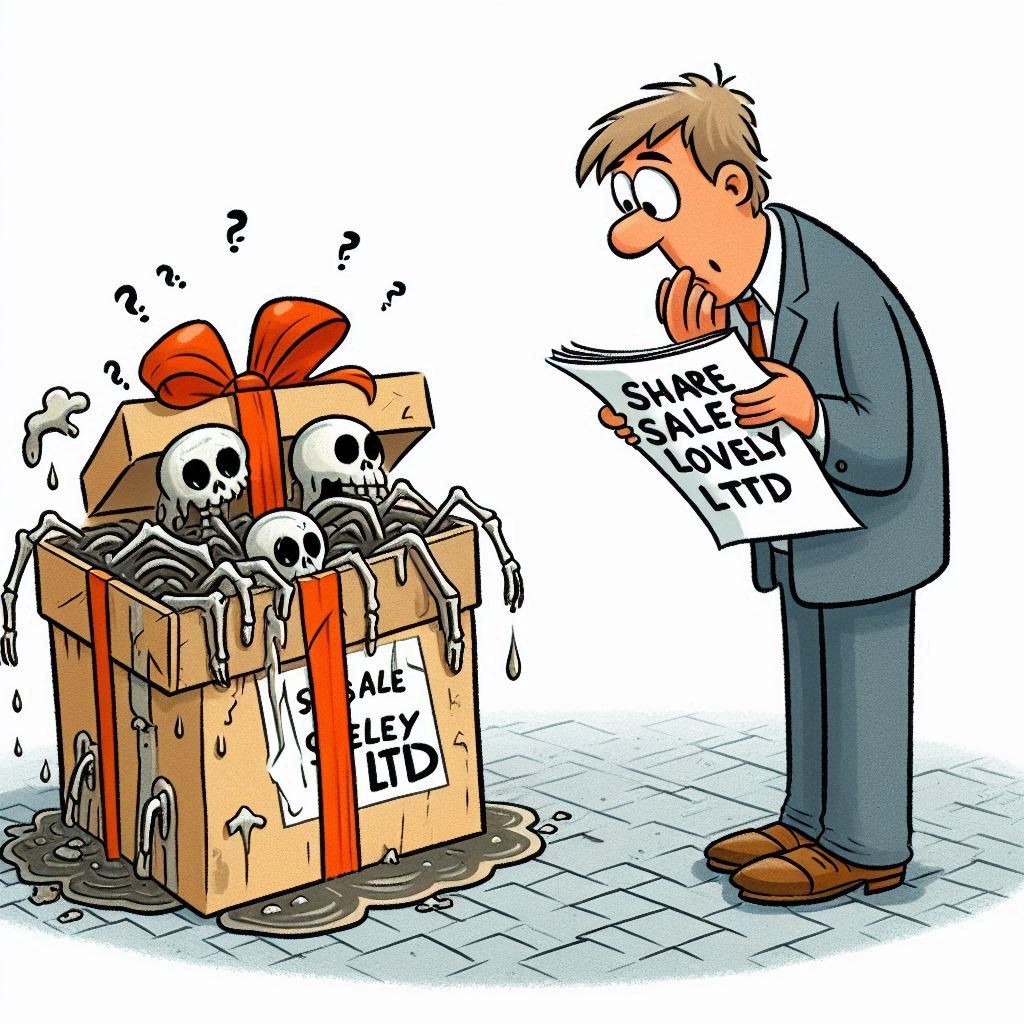
The other side of the coin on the simplicity and continuity front is that if you buy shares, you buy the whole company – warts, skeletons and all. It comes with all its liabilities – tax, environmental, regulatory, product liability, debts, contract liabilities, you name it. It also comes with all its assets, whether you want them or not – unprofitable contracts, Bentleys, guitar collections, you name it. Whereas with an asset sale, as a rule you don’t take on any liabilities (employment liabilities being the main exception) and you can cherry pick the assets you want to buy.
2. Due diligence and legal protections
Whilst you still need to know what you are buying in an asset purchase, there is generally less due diligence and legal protection (such as warranties and indemnities) needed than in a share sale because you are not taking on most liabilities. An important example is tax – this often needs extensive due diligence, and a share purchase agreement usually comes with a complex tax covenant schedule.
Some random examples of when you might go for an asset sale
• You’re not a company. If you are operating as a partnership, LLP or sole trader then you have no choice!
• You only want to sell a part of your business. You might just want to sell part of the business carried out by your company, which then continues to carry on the remaining part. So you need a carefully prepared asset sale which makes clear what is being kept and what is being sold. This can be quite tricky, particularly where the businesses share resources
• You are using an insolvency procedure. There are several possible reasons for this, whether your company is insolvent or not. Buyers usually don’t want to buy insolvent companies along with all their liabilities. In distressed situations, asset sales are often preferred because they can be quicker and more targeted.
• Fallouts between company owners. Someone buying a company will want to acquire all the shares in it. If the majority owners can’t persuade other shareholders to sell their shares (and they don’t have a shareholders agreement or Articles of Association with drag along provisions which they could use to force the others to sell) then an asset sale may be the only option. The controlling shareholders either push this through by virtue of controlling the board of directors which make the decision to sell; or they could possibly use the insolvency legislation and appoint an administrator.
• Marketing for sale. There are all sorts of complex restrictions on ‘financial promotions’, which may apply to a proposed share sale but won’t apply to an asset sale.
Some random examples of when you might go for a share sale
• Hive downs. Sometimes it happens that rather than selling a business (or a division of a business) as an asset sale there may be reasons for the company (or an administrator) to first set up a subsidiary company and transfer the business and assets to that subsidiary; and then sell the shares in the subsidiary to the interested buyer.
• Restrictions in key contracts. If for example a company relies heavily on an important contract with a third party (such as a long-term licence or distribution agreement), and that contract includes restrictions on the company assigning or sub-contracting the benefit of the contract (but no restrictions on there being any change of ownership of the company), then a share deal may be the sensible option, rather than doing an asset deal and having to ask for the third party’s consent.
Special tax supplement: which type of deal are sellers and buyers likely to prefer from a tax point of view?
In most cases the tax benefits for a seller of having a share deal rather than an asset deal will considerably exceed the tax benefits to a buyer of having an asset deal rather than a share deal.
Sometimes where because of the tax consequences sellers want a share sale and a buyer would prefer an asset sale there may need to be a bit of a trade off on the price to persuade (usually) the buyer to agree to buy the shares.
Why will sellers usually prefer a share sale?
• A chargeable gain on shares may be tax exempt for corporate sellers of shares because of the ‘substantial shareholding exemption’.
• Owner managers selling in a share sale can benefit (although not as much as they used to) from business asset disposal relief (formerly called entrepreneurs’ relief), reducing the capital gains tax. Non-owner managers can benefit from ‘investors’ relief.’
• Sellers may also prefer sale shares if an asset sale could result in the company having to pay balancing charges as a result of disposing of assets for which capital allowances had previously been claimed.
• Sellers can also benefit from rules allowing them to roll over any tax on any part of the sale price which is settled by the buyer issuing shares or loan notes rather than just paying cash.
• Whereas on an asset sale human sellers face dealing with a double tax charge (corporation tax on the sale price by the seller company, and then further tax in getting the proceeds out to the owners).
• On the other hand, on rare occasions where an asset sale might result in assets being sold at a loss, or at a value lower than their tax depreciation, the potential allowable losses or balancing allowances available to the seller might justify the seller preferring an asset sale.
Why will a buyer usually on balance prefer an asset sale?
• The buyer should be entitled to tax relief for accounting amortisation (ie to write down over a period of time) of the price paid for certain intellectual property and other intangible fixed assets. But since 2015 this doesn’t extend to goodwill or customers, so this is less of a factor now. (Most deals involve a price which is much more than book value. So on an asset sale, a large part of the price will be allocated to buying the ‘goodwill’. A buyer used to be entitled to corporation tax relief on writing down goodwill at the rate dictated by UK GAAP, but now generally can’t do this unless for example it is somehow connected to the value of certain IPR).
• If the price paid for plant and machinery is more than their current tax written down value, the buyer should be entitled to capital allowances reducing its future liability to corporation tax.
• Depending on what the buyer may have done in the past, it may be able to defer, or ‘roll over’, taxes on chargeable gains on past disposals of other similar assets to those included in the current asset deal. (This might also be an incentive for a seller of part of a business to want to sell assets, if they have an opportunity to roll over gains into new assets for the business they retain).
• The base cost for the acquired assets in the case of any future sale will be whatever the buyer paid for them, whereas on a share deal the same assets would remain owned by the target company and would retain their often much lower historical base cost.
• On an asset deal the buyer has the comfort of not taking on any of the historical tax liabilities of the target company which would come into the buyer’s group on a share deal (which could even include unwanted secondary liabilities for tax owed by other members of the seller’s group). Whilst on a share deal a buyer will obtain an extensive set of tax indemnities from the sellers, by structuring as an asset deal the buyer takes away all this risk.
• On the other hand the target company may have valuable ‘tax assets’, such as trading losses or capital losses, which might make a buyer more interested in buying the shares. However, there are complex anti-avoidance rules where a company with losses is transferred to new ownership.
• On either type of deal a buyer may need to pay stamp duty. In many asset deals there is no stamp duty involved, as the only types of asset nowadays that attract stamp duty are broadly stocks and shares (at 0.5%) and freehold or leasehold property. Usually the 0.5% rate on a share transfer is not a particular deterrent for the buyer. But if freehold or leasehold property forms a large part of the company’s value, a buyer may prefer to buy the shares, so it only pays 0.5% stamp duty on the share transfers rather than significantly more stamp duty land tax on the transfer of the property itself.
Whilst VAT is not payable on a purchase of shares but could be payable on the purchase of other assets, VAT should usually not be an issue because a business asset sale will usually be treated as a transfer of a going concern, which is VAT-exempt.
Many thanks to tax specialist Pete Miller of Jerroms Miller for vetting this special tax supplement.
And that wraps up my series of Guides on this subject. We can move on at last! Feel free to get in touch if you have a suggestion for any other Guides you might find useful.
What next? Contact me for a complimentary business sale consultation.
If you would like to discuss any of the issues raised in this Guide or any other issues relating to the possible sale of your business (or company!) please feel free to email me at andrew.james@onhandcounsel.co.uk to arrange a complimentary consultation where I can help you to identify what might be involved and how I can help. This will help you to avoid some of the pitfalls to which you might otherwise be exposed, and give you the peace of mind of knowing that you have an approachable competent corporate lawyer ONHAND who can provide you with experienced, effective and cost-effective advice and assistance.
Would you like to receive further Guides and other published articles containing legal updates and tips? If so, click below…
Sign up for more Guides and legal updates

